Hormonal acne in women
If your breakouts sit along the jawline, worsen the week before your period, and started or returned in your twenties, you are almost certainly dealing with a hormonal pattern. It needs a different approach.
Teenage acne is scattered across the forehead, nose and cheeks. Adult female acne behaves differently — and recognising the pattern is what changes the treatment.
How to recognise it
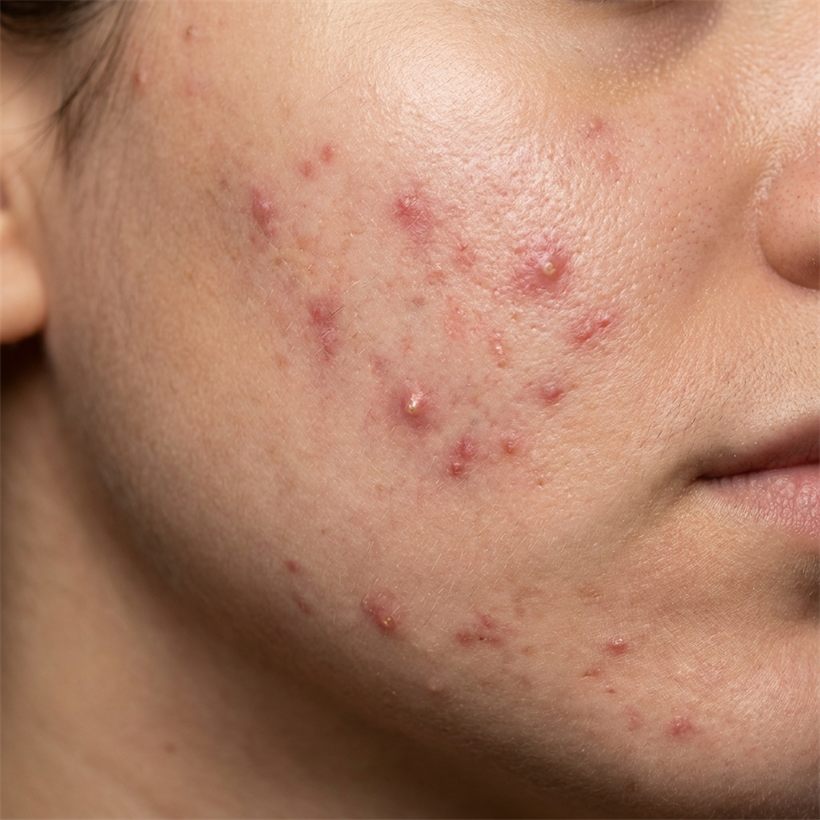
- Location: lower third of the face — jawline, chin, around the mouth, sometimes upper neck.
- Timing: flares in the seven to ten days before your period.
- Character: fewer but deeper lesions. Tender, under the skin, slow to come to a head.
- Age: appears or returns after 20, often for the first time in the late twenties or thirties.
- Behaviour: stubbornly resistant to face washes, scrubs and typical over-the-counter routines.
Note that "hormonal acne" does not mean your hormone blood tests will be abnormal. In many women the circulating hormone levels are entirely normal — the issue is how sensitive the oil glands are to normal androgen levels. So a normal report does not mean the diagnosis is wrong.
When to test, and what for
I do not test every patient. I do test when there are additional signs suggesting an underlying endocrine cause:
Get investigated if you also have
- Irregular or absent periods
- Excess coarse hair on the chin, upper lip, chest or abdomen (hirsutism)
- Hair thinning at the crown or a widening parting
- Dark velvety patches on the neck, underarms or groin — a sign of insulin resistance
- Difficulty losing weight, or rapid weight gain
- Sudden severe acne appearing over weeks in an adult
Typical workup: total and free testosterone, DHEAS, LH and FSH, prolactin, thyroid function, fasting insulin and glucose or HbA1c, and a pelvic ultrasound. Timed to the early part of the cycle where relevant.
The most common finding is PCOS — polycystic ovary syndrome — which is very common in South India. It is worth taking seriously beyond the skin: it carries long-term risks for diabetes, cholesterol and fertility. The acne is often the symptom that finally brings someone in, which makes it genuinely useful.
Treatment that works
Topicals — necessary but usually not sufficient
A retinoid (adapalene or tretinoin) remains the foundation, plus benzoyl peroxide or azelaic acid. Apply across the whole lower face, not just on individual spots. For deep hormonal lesions, topicals alone often plateau — which is where people wrongly conclude nothing works.
Anti-androgen therapy — the specific answer
| Option | How it works | Key points |
|---|---|---|
| Combined oral contraceptive pill | Lowers free androgens | Good evidence. Not suitable with migraine with aura, clotting history, or smoking over 35. |
| Spironolactone | Blocks androgen receptors in the oil gland | Very effective for jawline acne. Needs contraception — not safe in pregnancy. Potassium monitoring in some patients. |
| Metformin | Improves insulin resistance | Where PCOS with insulin resistance is confirmed. Helps the whole picture, not just skin. |
| Isotretinoin | Shrinks oil glands | For scarring or treatment-resistant cases. Strict contraception mandatory. |
These all require prescription and monitoring. Please do not take a friend's leftover pills — spironolactone in particular needs the pregnancy question addressed properly.
What lifestyle change genuinely helps
I am careful here, because women with PCOS are often handed unrealistic advice and then blamed for it. What has reasonable evidence:
- Reducing high-glycaemic foods. Refined carbohydrates spike insulin, which raises free androgens. In Kerala this practically means portion-controlling white rice, and adding protein and vegetables to each meal rather than eliminating rice entirely — an instruction nobody follows.
- Cutting back dairy, particularly skimmed milk and whey protein supplements, has moderate evidence. Worth a two-month trial.
- Regular exercise and modest weight reduction if overweight — improves insulin sensitivity, which improves acne, cycles and long-term risk together.
- Sleep and stress. Cortisol worsens inflammatory acne. Not a cure, but real.
What does not help: eliminating "heat-producing" foods, avoiding all oil, or the elaborate restriction diets sold online. There is no evidence for those and they make eating miserable.
Timeline
Hormonal acne is slower than teenage acne. Expect three months before meaningful change on anti-androgen therapy, and six months for the full effect. Marks left behind take longer still.
The cyclical nature also means judging progress week to week is useless. Compare the same point in two different cycles instead — for example, how bad was the pre-period flare in March versus in June.
One thing worth knowing about relapse
Hormonal acne tends to return when treatment stops, because the underlying androgen sensitivity has not changed. That is not treatment failure — it is the nature of the condition. Many women stay on a low maintenance dose or a topical retinoid long-term, which is entirely reasonable, and we plan for it from the start rather than treating each relapse as a fresh crisis.
Frequently asked questions
The pattern is the clue: lesions on the jawline, chin and around the mouth, deeper and more tender than surface pimples, flaring in the week before your period, and appearing or returning after age 20. Hormonal blood tests are often normal — that does not rule it out.
Not always. Testing is important if you also have irregular periods, excess facial or body hair, scalp thinning, dark velvety neck patches, or unexplained weight gain — that combination suggests PCOS or another endocrine cause worth investigating.
It is controllable rather than curable. Anti-androgen treatment, insulin-sensitising measures where relevant, and a topical retinoid control it well, but it commonly returns if all treatment stops, because the underlying androgen sensitivity persists.
It is effective and widely used for hormonal acne in women, but it requires a prescription, reliable contraception because it is unsafe in pregnancy, and monitoring in some patients. It should never be taken from someone else's prescription.
Reducing high-glycaemic foods and dairy has moderate evidence and is a reasonable two-month trial, particularly with insulin resistance. On its own it rarely clears hormonal acne — it works alongside medical treatment, not instead of it.
Three months for meaningful improvement, six for the full effect. Because the acne is cyclical, compare the same phase across different cycles rather than week to week.